The Gray Commons / Community guide
Testing 101
Read a real COA, compare purity and vial content, check endotoxin and TFA, and choose a lab for your next test.
On this page
You have a vial, a seller’s promise and a COA. Let’s work out what the report actually says: what’s in it, how much is there, and which contamination checks were done.
What is testing?
Testing turns a claim about your lyo into measurements. A COA (certificate of analysis) is the lab’s record of those measurements. Start with three separate answers:
- Identity: did the lab find the peptide you ordered?
- Purity: what share of the included chromatographic signal belongs to that peptide?
- Content, often called “mass”: how many mg of the peptide were measured in the vial?
Two useful buyer comparison targets
Purity: above 98%. Compare the reported percentage and its method.
Content: within ±10% of the label claim. For a vial sold as 30 mg, that means 27–33 mg.
Use these to challenge a seller’s quality or fill claim. They are not a safety clearance for injection; contamination needs its own tests.
How do I read my test results?
First connect the report to the sample
Find the lab, report number, peptide, batch, dates and result units. Keep the complete PDF, including the notes. Then verify it with the issuing lab—a cropped screenshot is only a starting point.
HPLC: follow the peaks, then the numbers
Think of the chromatogram as a row of hills. The lab identifies the target peptide’s hill using its method and reference material; the tallest hill alone is not proof of identity. Nearby smaller peaks can represent related impurities or other detected material.
For an area-based purity result, the lab measures the area under the included peaks, not their height. Which peaks enter that total can change the percentage. TrustPointe explains how its purity calculation works.
Let’s read a real example. This historical retatrutide chromatogram shows four areas: 37.642, 10.782, 8.219 and 648.220. The last one is labelled retatrutide. The handwritten red crosses mark the first two peaks for exclusion in a comparison calculation.
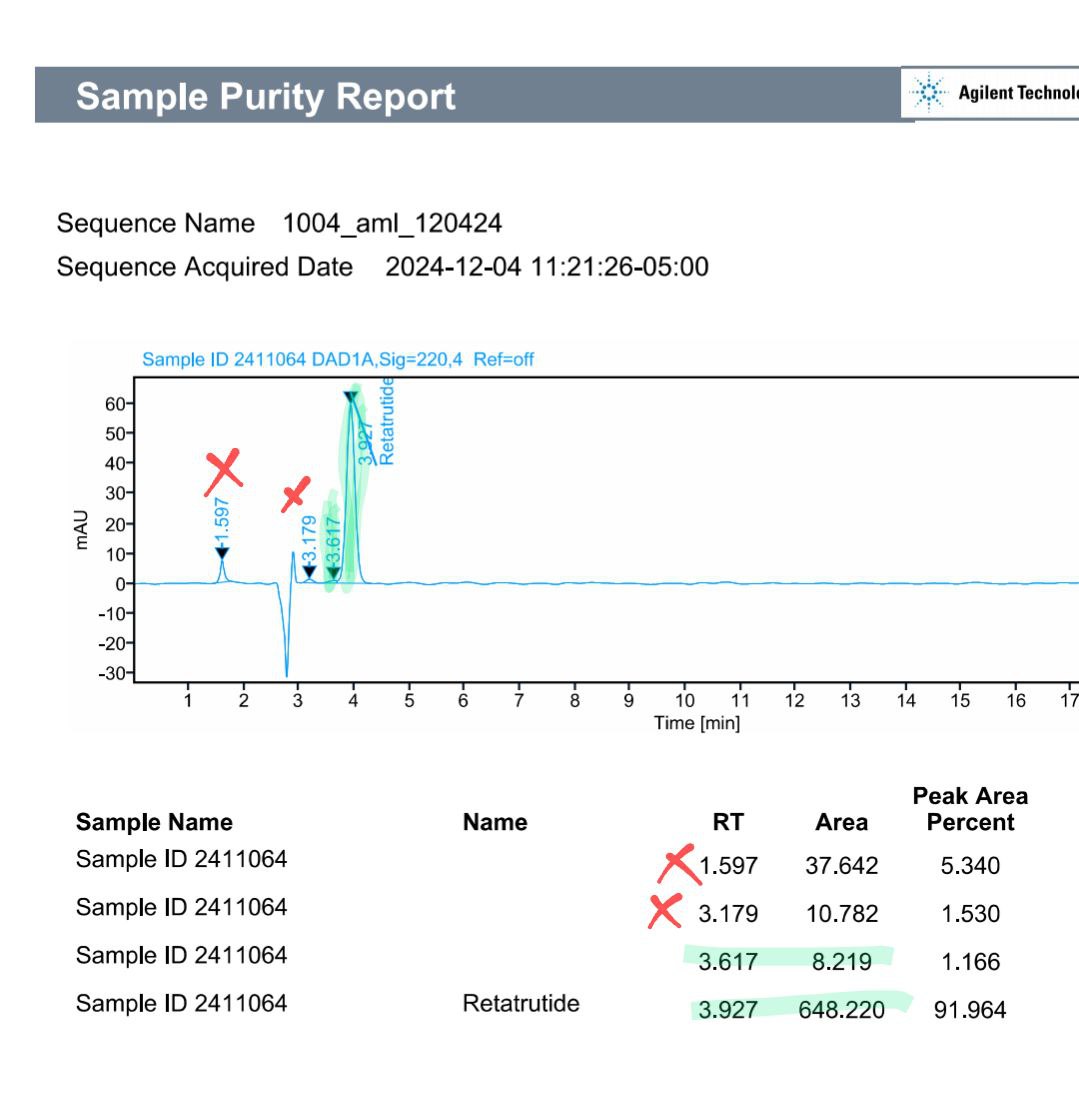
That is the target peak. Follow the two red crosses and the green-highlighted 8.219 peak into the calculation below.
Select the report to enlarge.
| What goes into the total? | Calculation | Result |
|---|---|---|
| All four listed peaks | 648.220 ÷ 704.863 × 100 | 91.964% |
| Target plus the 8.219 peak | 648.220 ÷ 656.439 × 100 | 98.748%, or 98.75% |
Same data. Different denominator. Excluding the two crossed-out areas raises the number by about 6.78 percentage points. The original COA still reports 91.964%; 98.75% is a recalculation, not a replacement lab result.
The COA calls those two signals atypical peaks and describes the 8.219 peak as consistent with degradation. It does not identify the crossed-out material as harmless filler. The useful question to send the lab is:
“Were the peaks at 1.597 and 3.179 minutes included in the purity result? What evidence supports including or excluding them?”
That question gets you further than asking why one lab’s number is “better.” Different methods can detect different components, and different samples can also give different results.
Content: did the vial meet its label claim?
Read the mg result separately. In the Peptide Test report below, a vial described as 10 mg measured 10.45 mg—4.5% above the claim. Its 91.964% purity is a separate finding. Meeting the fill target does not fix a low purity result.
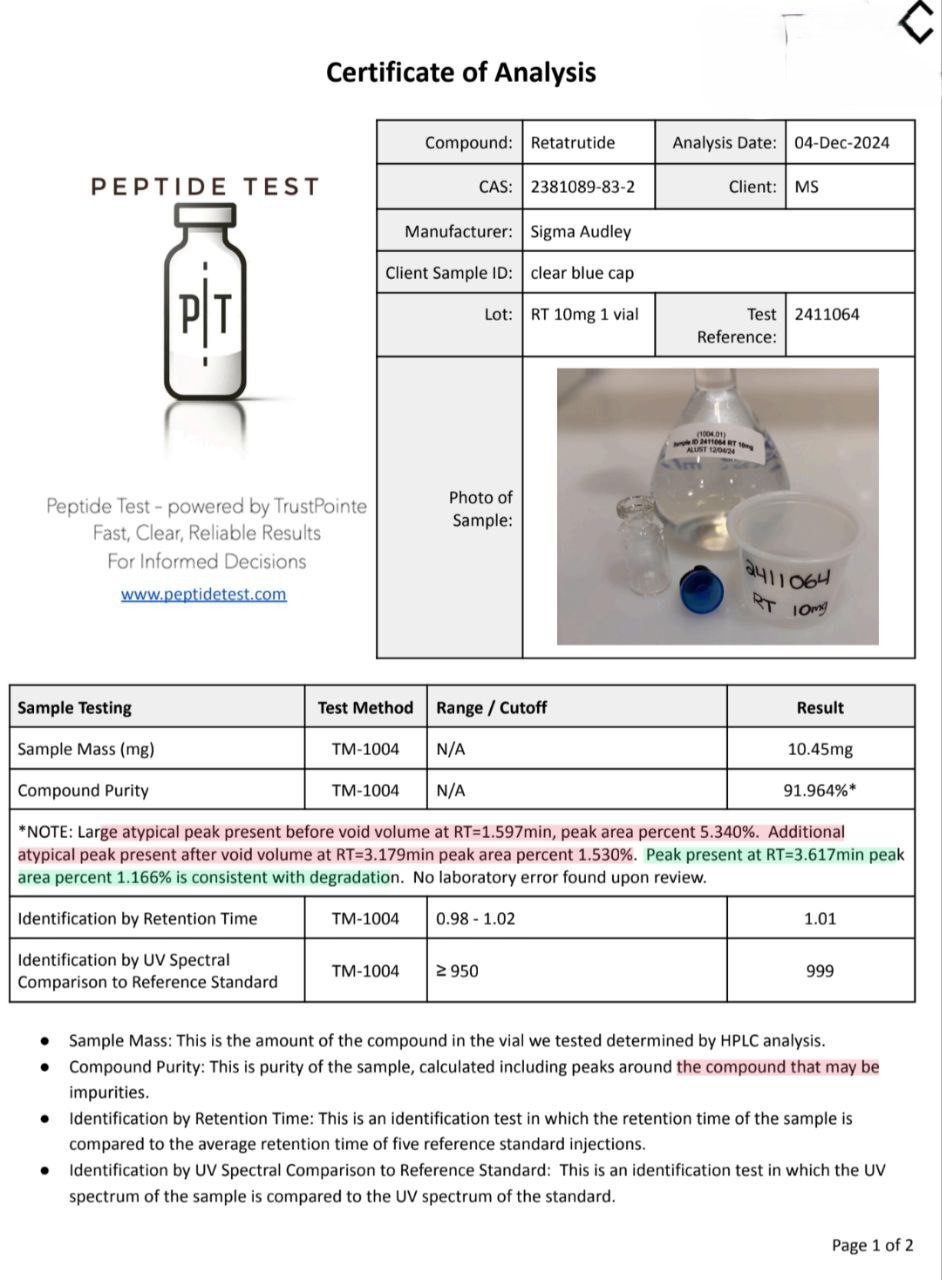
Test 2411064, dated 4 December 2024. Read the highlighted notes with the result; they explain which signals need attention.
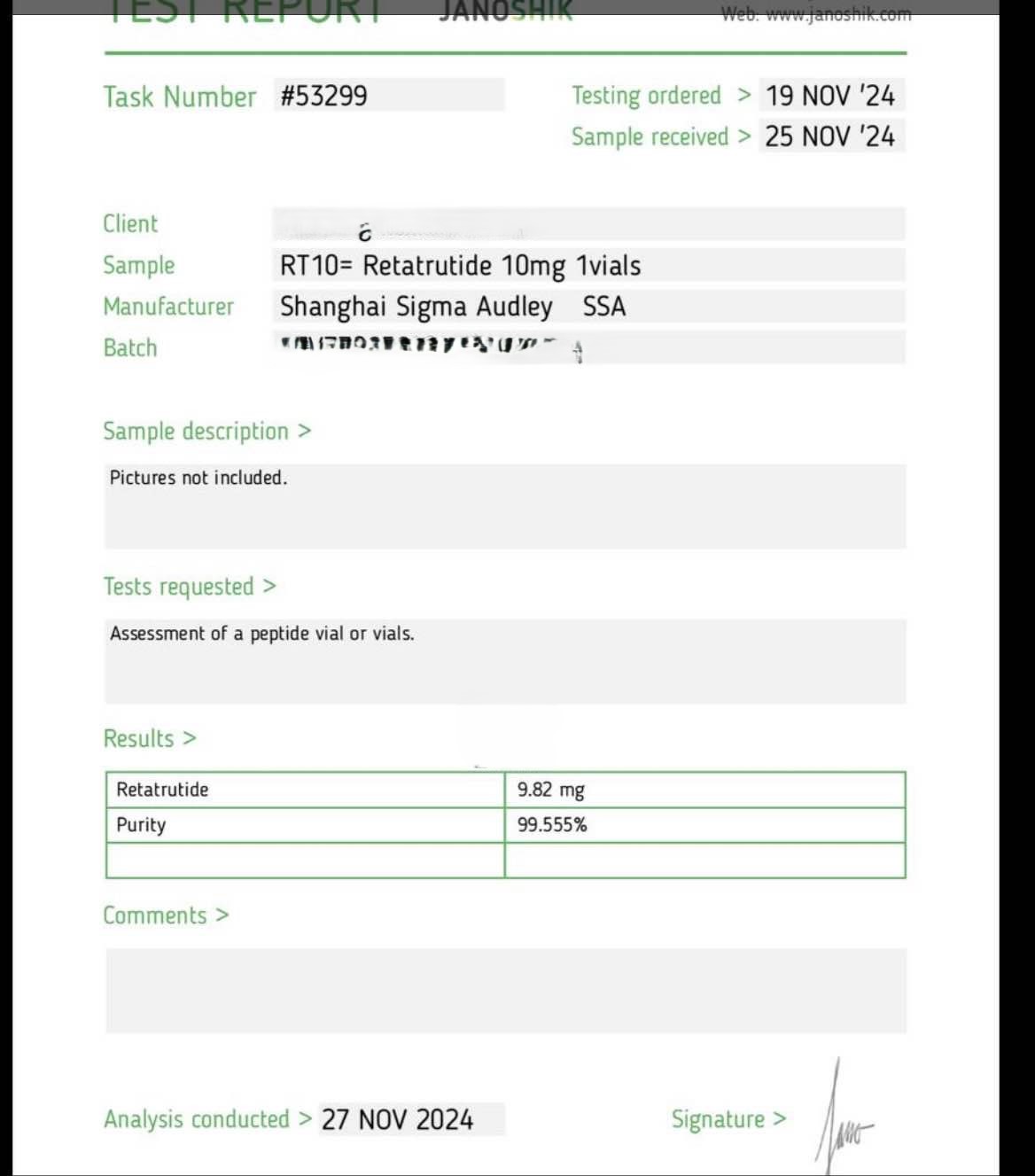
Task 53299, dated 27 November 2024. The content is 1.8% below a 10 mg claim. This is a different sample record, not a repeat measurement of the first vial.
Select either report to enlarge. These historical excerpts illustrate reading a report, not a current vendor recommendation.
Check an underfill or overfill
Difference (%) = (measured mg − labelled mg) ÷ labelled mg × 100
Here: (10.45 − 10) ÷ 10 × 100 = +4.5%.
A minus sign means under the claim; a plus sign means over. Extra content is still a mismatch to account for, not automatically a bonus.
Endotoxin: read the result in the right units
Endotoxins are toxins from certain bacteria. They can remain after the bacteria die, and an injection contaminated with them can cause fever, shaking chills and—in severe cases—shock. A clear solution and a high HPLC purity result do not answer this question. Ordinary bacteria-removing filters do not reliably remove endotoxins. FDA explanation.
Look for EU, meaning endotoxin units. Then check whether the number is per vial, per mL or per mg. Those are not interchangeable.
A report-reading example: 6 EU in a vial containing 30 mg
6 EU per vial ÷ 30 mg per vial = 0.2 EU/mg
If the result instead says less than 6 EU per vial, keep that sign: less than 0.2 EU/mg. Do not turn “less than” into an exact measurement.
Use the measured peptide content, when available, rather than assuming the seller’s label is exact. For a result in EU/mL, use the lab’s sample concentration: EU/mL ÷ mg/mL = EU/mg. Ask whether dilution corrections are already included; do not apply them twice.
“Under 10 EU/mg” is not a universal safety cutoff. A limit on one manufacturer’s API specification is not a universal rule for every peptide vial. The relevant limit depends on the product and maximum administered dose. The FDA’s explanation of endotoxin specifications uses a dose-based calculation, not one blanket 10 EU/mg cutoff.
Get a usable answer from the lab: “What limit did you compare this result with, in what units, and did the sample pass the method’s interference checks?” A report should make the result and comparison basis clear. A missing endotoxin test stays not tested, even when the purity row looks excellent.
TFA: what to look for on an F-19 NMR report
TFA is used during peptide manufacture and purification. Some can remain with the peptide, including as a counterion—a small charged partner attached to the peptide’s salt form. That is why a peptide can show high chromatographic purity and still contain TFA. A targeted fluorine-19 NMR test can measure it. Research on TFA measurement in peptides.
On a spectrum, the TFA signal is often near −75 to −76 ppm, depending on the reference and conditions. That is the region to ask the lab to identify. Example in peptide research.
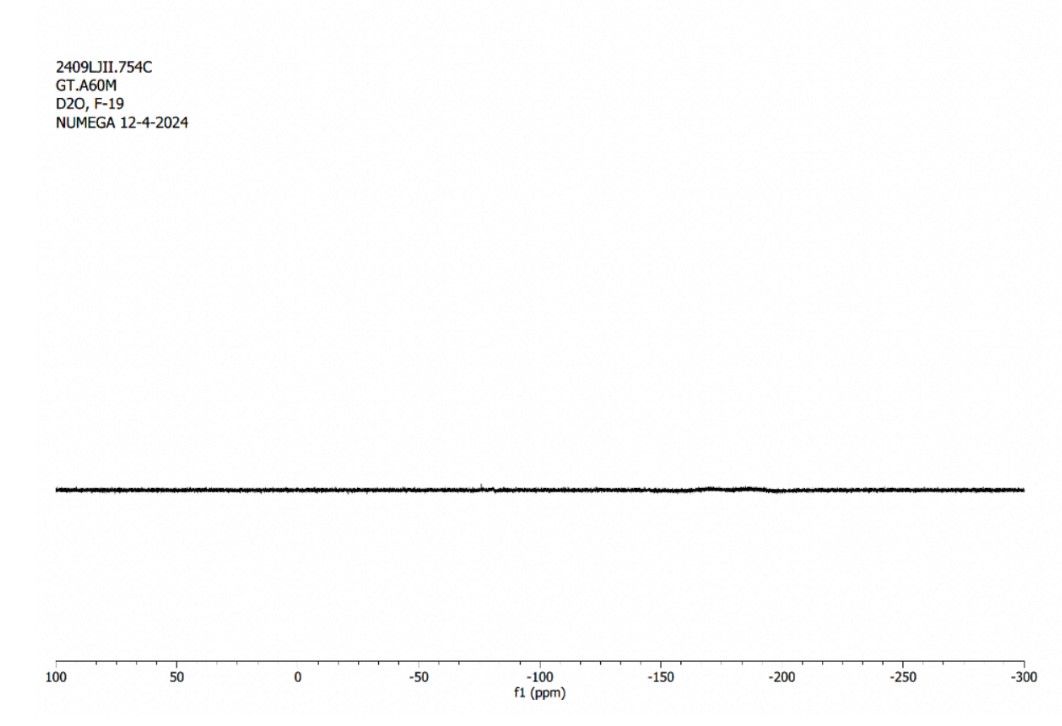
Pair the spectrum with the TFA result: a measured amount, or “not detected” with its detection limit. That turns a picture into something you can compare.
Select the spectrum to enlarge.
Ask for TFA in mg/vial or a clearly defined percentage, plus the reporting limit. A flat trace supports “not detected at this method’s sensitivity,” not “absolutely none.” TFA testing does not replace a panel for other solvents; Residual Solvents explains the difference.
What tests do I order?
Build the request around the gaps in your batch’s evidence. Start with the core measurements, then add separate contamination checks. A new batch needs new evidence.
🧪 Core checks: identity, purity and content
For each new order or batch, arrange buyer-controlled sampling for peptide identity, chromatographic purity and content in mg/vial. Ask whether the quoted package includes all three, and request the chromatogram and peak table.
“HPLC testing” on an order form is not enough detail: an area percentage alone cannot tell you the mg. The lab needs an appropriate quantitative assay for content and suitable evidence for identity.
Endotoxin: a separate contamination check
Include an endotoxin assay, such as LAL, when assessing contamination in material intended for injection. It is not an optional cosmetic upgrade to the purity score. Ask how many unopened vials it needs and how the result will be reported.
Both Janoshik’s GLP-1 service and Peptide Test’s endotoxin service currently request a separate vial for this test. Check before packing.
📅 Periodic checks: TFA and other targeted tests
Use TFA quantification to investigate the salt form or monitor a source over time. Repeat it when the source, manufacturing process or formulation changes. Ask for a residual-solvent panel or elemental testing when those are the concern; one TFA result cannot answer all three questions.
What about sterility?
Sterility is a separate question from endotoxin. Discuss the method, sample count and unopened-vial requirements with the lab. Do not mark it “unnecessary” because you plan to use a filter or BAC water. Keep it as a separate line in your testing plan.
Which lab should I use?
Choose the service that fits your question and shipping location. For a basic peptide order, compare Janoshik and Peptide Test first. For a focused F-19 NMR question, include NuMega in the enquiry.
| Lab | When it belongs on your shortlist | Check before sending |
|---|---|---|
| Janoshik | Accepts samples internationally. Its GLP-1 blind service lists identity, amount and purity, with TFA and endotoxin add-ons. | Shipping time and requirements; a separate endotoxin vial; whether raw data is included in your order. |
| Peptide Test | US-based option for purity/content testing, with online group-test coordination and a separate LAL endotoxin service. Useful when domestic US shipping simplifies the job. | Current turnaround for your full panel; extra endotoxin vials; whether variance results identify each individual vial. |
| NuMega Resonance Labs | San Diego analytical lab listing F-19 NMR and quantitative NMR. Worth asking when TFA measurement is the specific gap. | Request quantitative TFA, the reporting limit, sample amount and price. Confirm this scope; a generic NMR spectrum is not the same order. |
Service details checked 28 September 2026. Use the linked catalogue or written quote for current prices and completion dates; turnaround starts after receipt, not when you post the package.
Other US options include TrustPointe for purity/potency and microbiological services, and Freedom Diagnostics for HPLC, LC-MS identity, content and endotoxin services. Compare the actual panel, not the number of logos on the report.
A short enquiry you can reuse
“I have unopened lyophilized tirzepatide vials from one batch. Please quote identity, purity, content in mg/vial and endotoxin, with raw data. How many vials do you need, what units and limits will you report, and what is the current turnaround including all requested tests?”
🔎 Verify a COA before you trust the screenshot
- Open the lab’s official site yourself. Follow its verification link. Check the domain before entering anything; a QR code can lead to a lookalike site.
- Retrieve the original record. Janoshik asks for the task number and unique key. Peptide Test and TrustPointe provide their own verification portals, linked from their official sites.
- Match the details. Compare the compound, report ID, dates, batch/sample description, mg, purity and notes with the seller’s screenshot. Look for cropped qualifications or a result copied from another peptide.
- Connect it to this order. A genuine old COA can still be reused for a different batch. Ask what connects the tested sample to the batch being sold: batch records, vial identifiers and who selected the sample.
Missing ID, failed lookup or a mismatch? Put the claim on hold. Request the original link and ask the lab to resolve it. A typo or access problem is possible; a seller who refuses verification has not supplied usable evidence. TrustPointe has documented falsified COAs, so this check is worth doing.
For stronger 3P evidence, select a vial from an ordinary buyer’s order. A lab can be independent while the seller still cherry-picks what it sends. Buyer selection and a recorded batch trail address that problem; hiding the supplier name from the analyst can add blinding.
What is group testing?
A group test spreads the bill across people checking the same batch. Agree on the plan before anyone pays:
- Match the batch and label claim. Do not mix different strengths into one comparison.
- Select and track the vials. Record whose order each came from; ask for individual results when comparing fill variation.
- Agree on the panel, cost and report access. Include shipping and any separate vials for contamination tests.
- Share every result, including the disappointing ones. Keep corrections attached to the original report.
Pool the budget, not the liquid. Separately tested vials let you see differences that a blended sample could hide. Peptide Test describes its variance-testing options here.
Share your 3P test results
Help the next person check the same evidence. Post the complete report or verification link, batch, label claim, sample-selection details and who funded the test. Redact private contact, payment and shipping details; keep the analytical notes visible.
Add a short summary: “Identity confirmed; content … mg/vial; purity …%; endotoxin … in the reported units; TFA tested/not tested.” Separate what the lab measured from your interpretation. If something is unclear, bring the question with the report—someone else may have worked through the same format.
Find available discussion channels through the community section on our homepage.
COA and testing questions
How do I read a Janoshik COA?
Start with the peptide identity, sample or batch, dates and report number. Read purity and content in mg/vial separately, then check which contamination tests were included. Use the task number and unique key on Janoshik’s official verification page to retrieve the original. The COA verification checklist walks through the comparison.
Does 99% purity mean a vial contains its labelled dose?
No. Purity describes the measured sample under the lab’s method; content or assay tells you the measured amount. A high purity percentage does not establish mg/vial, sterility or an endotoxin result. Look for each result separately.
Does a genuine COA prove the vendor’s current batch was tested?
No. A genuine report can be reused for a different batch. Match the report to the order and ask who selected the sample. Buyer-selected vials with a documented batch trail provide stronger evidence than an unexplained screenshot.
Which lab should I send peptide samples to?
Start with the tests you need, then compare sample requirements, location, total price and turnaround for that exact panel. The lab comparison explains the differences. Ask for a written quote before shipping.
Continue reading
- Gray 101 — put testing into the wider beginner journey.
- Residual Solvents — read TFA and solvent results in more detail.
- Lyophilized Peptides — compare what you see in the vial.
- Dictionary — look up an unfamiliar term.