The Gray Commons / Community guide
Compounding Sources
Where does the ingredient come from, and what happens before it reaches your vial? Follow the supplier COAs, pharmacy replies and questions worth asking.
On this page
A US pharmacy label tells you who dispensed the vial. It does not tell you where the peptide was made. The ingredient can travel through manufacturers and distributors before a pharmacy turns it into a finished preparation.
The 2024 Red Rock Pharmacy correspondence below puts names to that chain: Genohope and Alvantis, both Chinese suppliers, appear alongside specific dispensed lots. That is a useful finding. The next question is what happened between the ingredient and the vial in someone's hand.
- Follow the names — two supplier certificates and the pharmacy's replies. See the documents ↓
- Decode the powder — raw API, base, salt and lyo describe different things. Compare the forms ↓
- Check the claim — turn “same factory” into questions someone can answer. Use the checklist ↓
Where do compounding pharmacies get their tirzepatide?
They can buy the active pharmaceutical ingredient, or API, from an ingredient manufacturer or through a distributor. The pharmacy's name and the original manufacturer's name may be different. Here is the route to ask about:
- Make the ingredient
An API manufacturer produces the peptide and assigns a batch number.- Move the ingredient
A distributor or repackager may handle it before it reaches the compounder.- Make the finished vial
The compounder formulates, prepares and checks the product it dispenses.
Buyer's takeaway: ask who made the API, then ask who prepared the finished product. A domestic shipping address answers neither question. FDA's supplier-traceability guidance also tells compounders to identify the original manufacturer and check their suppliers.
What do 503A and 503B mean?
503A generally means compounding for an identified patient with a prescription. 503B outsourcing facilities can also supply healthcare providers without an individual patient's prescription and must follow current good manufacturing practice requirements. Neither designation makes a compounded drug FDA-approved. The two frameworks
Which Chinese suppliers appear in the pharmacy records?
The November 4, 2024 reply lists Genohope for dispensed lot 102205CH and Alvantis for 091702CH. The supplier COAs below identify their own API lots. Keep both sets of numbers: an ingredient batch and a pharmacy's finished batch are different records.
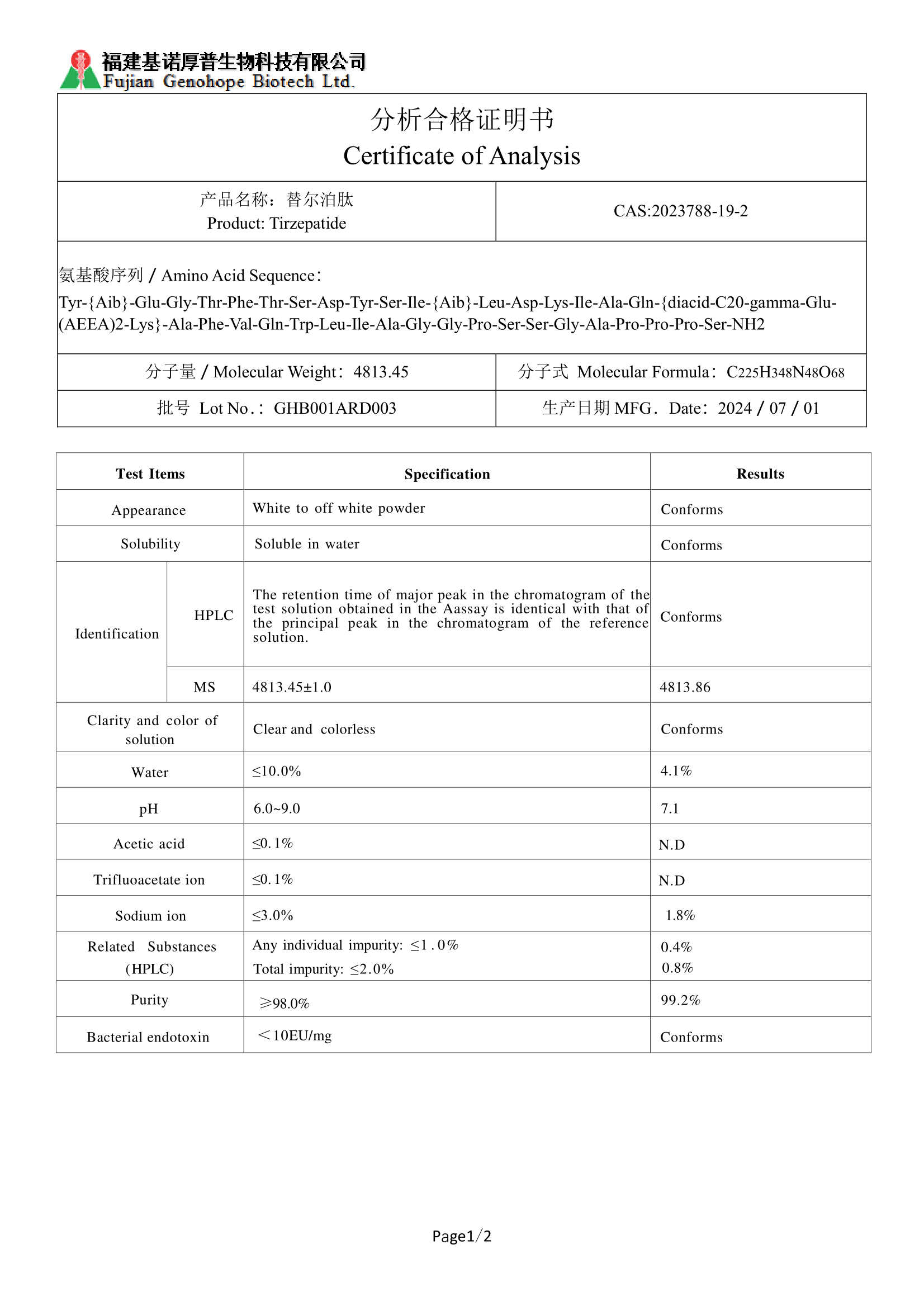
API lot GHB001ARD003 · July 1, 2024. Reported purity: 99.2%. Look below that number: the page also has water, pH, TFA and endotoxin entries. Page 1 of 2.
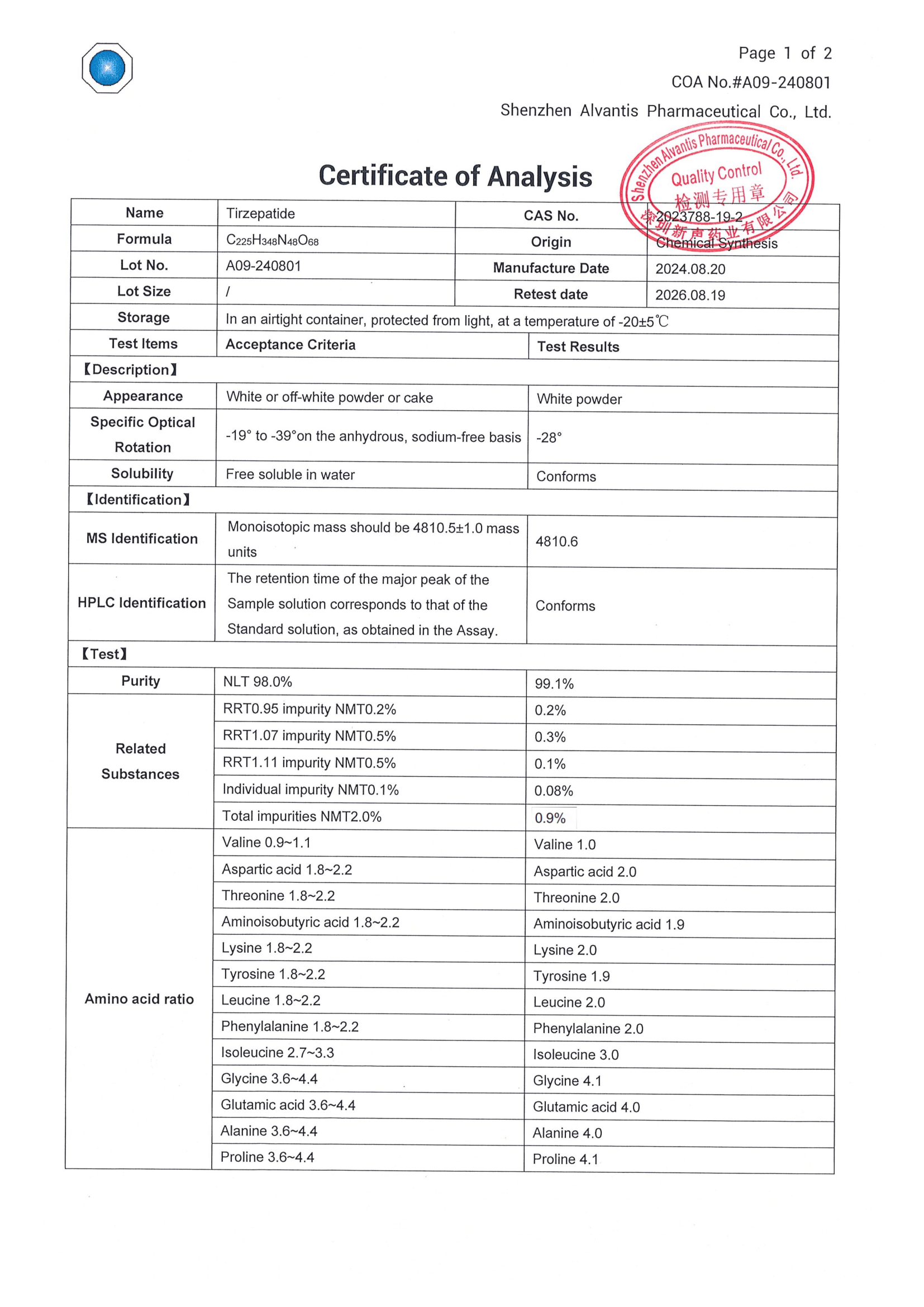
API lot A09-240801 · August 20, 2024. Reported purity: 99.1%. The storage instruction specifies −20 ± 5°C. Page 1 of 2.
Tap a certificate to enlarge it. These are supplier reports; request both pages and the finished-batch link when checking your own vial.
The useful detail is bigger than “Chinese powder”: an ingredient COA and a finished-vial test answer different questions. A supplier's purity result is the starting point. Ask the pharmacy for the finished-batch results too. Testing 101: read a COA
What did Red Rock say about its raw API and finished batches?
These two replies answer the questions people actually ask: who supplied the ingredient, and what did the pharmacy do with it? Each dated excerpt is followed by readable text.
November 4, 2024: Genohope and Alvantis
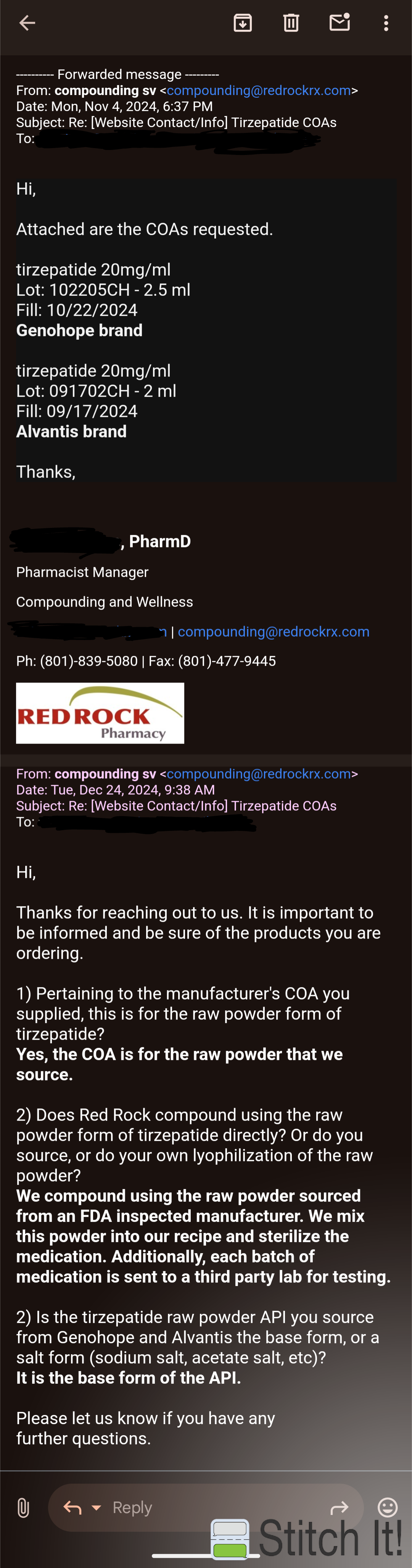
A cropped view of the email header and batch details. Original personal-information redactions retained.
Batch details transcribed from the email
Genohope brand — tirzepatide 20 mg/mL; lot 102205CH; 2.5 mL; filled October 22, 2024.
Alvantis brand — tirzepatide 20 mg/mL; lot 091702CH; 2 mL; filled September 17, 2024.
December 24, 2024: raw powder, preparation and base form
The pharmacy's answers, with the key excerpts transcribed below.
Red Rock Pharmacy's reply · selected verbatim excerpts
“We compound using the raw powder sourced from an FDA inspected manufacturer.”
“It is the base form of the API.”
In plain English: the pharmacy says it buys raw API, makes its liquid formulation, sterilizes the medication and sends each finished batch to a third-party lab. The inspection description above is the pharmacy's statement in its 2024 reply.
The question to borrow: “Can you provide the ingredient report and the test results for the finished batch I received?” These archived replies are useful examples of the detail to request for a current order.
Raw API vs. lyophilized powder: why do the vials look different?
Why does a pharmacy buy raw powder while you receive a little puck? They are buying for different next steps. A compounder buys an ingredient to turn into a measured liquid preparation under controlled conditions. A seller offering individual dry vials supplies a product that still needs liquid added before it becomes a solution. Drying can help storage stability; the actual formulation and shipping conditions still matter.
The confusing bit is the listing language. “Base” tells you about the chemical form; “lyo” tells you about drying. You can describe one material with both terms. Here is the group-chat translation:
- Raw API = the ingredient
Bulk material bought for further formulation. It is not a finished, ready-to-inject medicine. - Base or salt = the chemical form
Ask which form is in the vial. You cannot read that answer from the shape of the powder. - Lyo = freeze-dried
Water has been removed to leave a dry cake or powder. “Lyo” alone does not tell you whether it is base or salt.
Where does mannitol fit in? It is an extra formulation ingredient that can help build the cake. Some products use it; others use different ingredients. Neither mannitol nor conversion to a salt is a mandatory step for every freeze-dried peptide. Ask what is actually in your vial. Freeze-drying basics
There is no automatic “two months at room temperature” allowance. The Alvantis certificate above actually specifies frozen storage. Ask for storage and shipping evidence for the particular material. A pharmacy's liquid and a home-reconstituted vial can also differ in concentration, ingredients, pH and storage life; copying the pharmacy's use-by date skips those differences.
Compounded medicine vs. a gray-market research vial
| What to compare | Compounded medicine | Gray-market research vial |
|---|---|---|
| API source | Ask for the original manufacturer and API lot; this 2024 example names two Chinese suppliers. | Ask for the manufacturer and batch behind this kit. “Same factory” needs a traceable link. |
| Form supplied | Red Rock's reply describes raw base-form API turned into a finished liquid. | Often sold as lyo powder or a puck. Request the actual chemical form and full ingredient list. |
| Sterile preparation | The compounder is responsible for its preparation process and finished-product controls. | Adding BAC water at home is not a validated sterilization process. Ask what was controlled before the vial was sealed. |
| Testing to request | Ingredient COA plus the relevant finished-batch results. | Batch-linked identity, content and purity results, plus the relevant contamination tests. A 3P report should identify the tested sample. |
Same country is not the same product. Even a shared API manufacturer would leave formulation, handling, filling, testing and storage to compare. Judge those steps on evidence, not a reassuring factory name.
For the practical follow-ups, use Lyophilized Peptides: visual red flags, Dictionary: counterions and Residual Solvents: TFA and solvent tests.
What do the China and US labeler charts actually tell us?
The useful reveal: an American pharmacy label can sit at the end of a Chinese API supply chain. The Red Rock replies give this story actual supplier names. In the 2024 chart below, China also has the largest group of listed names: 20, compared with 8 in the US and 1 in India.
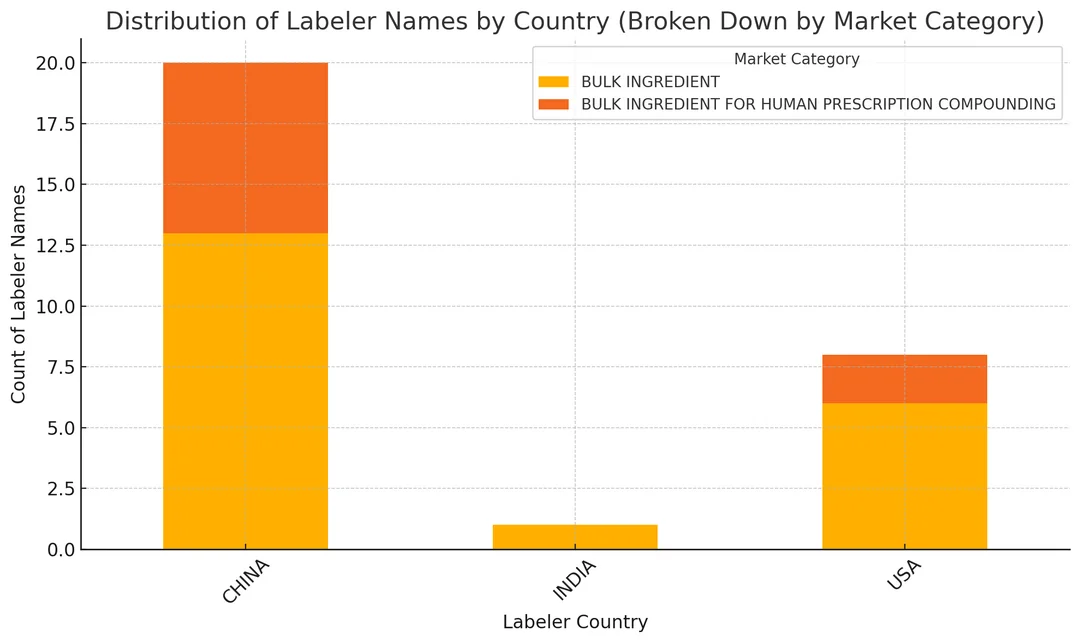
Country counts describe listed names, not production volume or market share.
Tap to inspect the labels and categories.
Read past the name on the label. A labeler can make the ingredient, repackage it or put its name on the product. Ask which role the company performs and where the original factory is. FDA listing is not product approval. How the NDC Directory works
How did the recorded labeler names change?
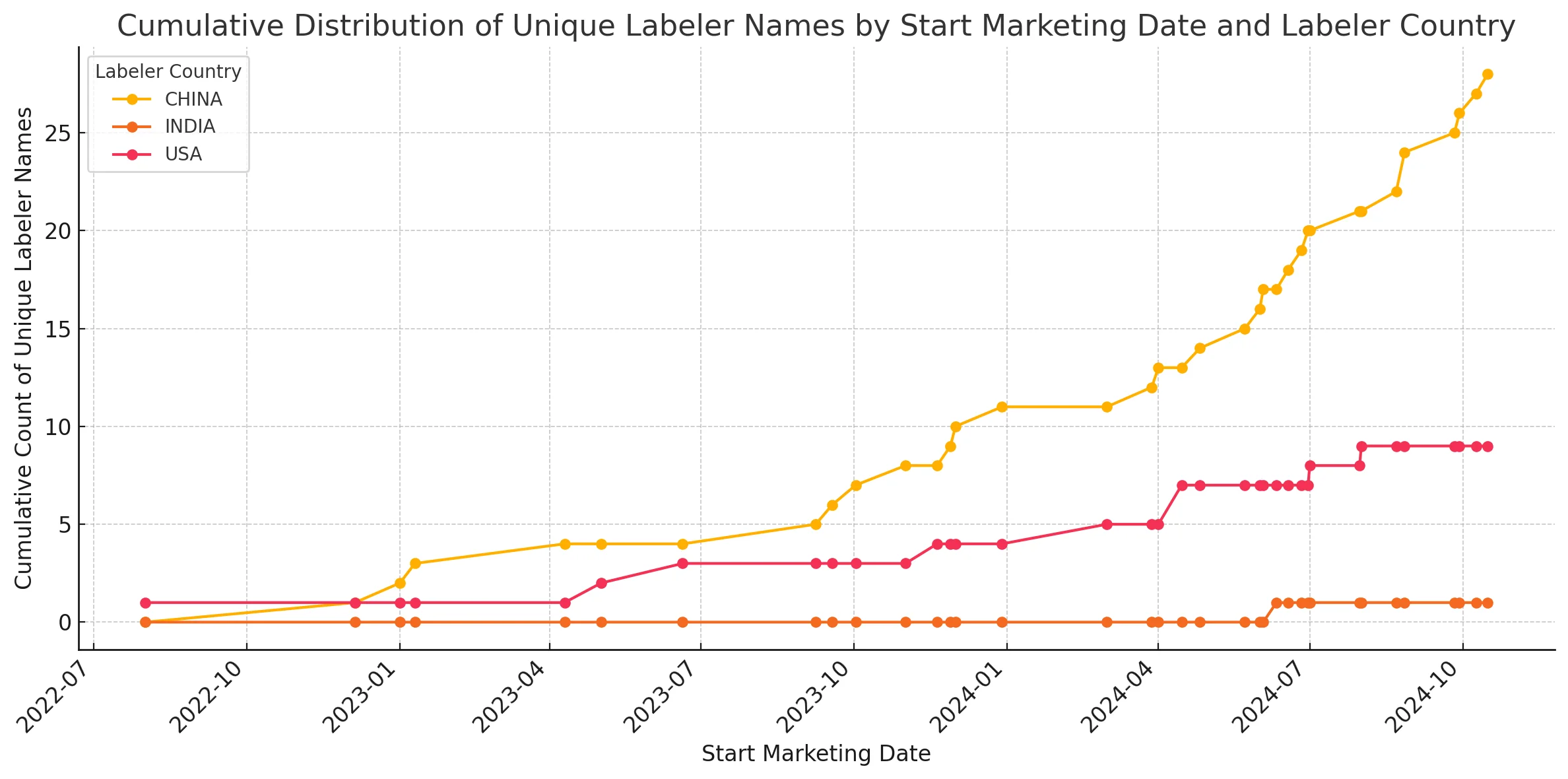
Historical cumulative counts plotted by marketing start date. The two charts use different totals; compare the pattern, not a combined market-share figure.
A lead for asking where the API came from. Your batch documents provide the next step.
What should I ask before trusting “the same source”?
Keep it short. A useful answer has names, batch numbers and documents:
- Who actually made it? Get the API manufacturer's legal name, manufacturing site and batch number. Separate the factory from the distributor.
- Where is the batch link? Match the ingredient lot to the finished vial or kit. A familiar company name on an unrelated COA is not the missing link.
- What happened after manufacture? Ask who formulated, filled and sealed the vials, and which ingredients were added.
- What was tested? Ask for complete reports and verification details. Distinguish raw-ingredient results from finished-product results.
- What supports storage and shipping? Get the specified conditions and the evidence behind the expiry or use-by date. “Lyo ships fine” is not a temperature record.
If the answer stops at “pharmacy grade” or “same factory,” the useful details are still missing. Pause the purchase rather than paying extra for a claim nobody will document.
Compounding sources: common questions
Is gray-market tirzepatide the same as compounded tirzepatide?
You cannot establish that from the name or country of origin. A compounded medicine and a research vial may claim the same peptide, but their formulation, batch controls and finished-product testing can differ. The records on this page identify suppliers for one pharmacy's historical example; they do not connect a particular gray-market kit to that supply chain.
Why are US compounding pharmacies stopping tirzepatide?
The shortage-based route for making copies ended after FDA reaffirmed that the shortage was resolved in December 2024, followed by enforcement and court updates in 2025. This is not a blanket ban on every individualized prescription. FDA's April 1, 2026 update describes limited 503A conditions, including a documented significant difference for an identified patient, and states that tirzepatide is on neither the shortage list nor the 503B bulks list. Current policy, checked September 28, 2026
Does freeze-dried tirzepatide have to be a salt?
No. Freeze-drying describes how water was removed; base or salt describes the chemical form. Get the material specification and ingredient list instead of identifying the form from the puck's appearance. The preparation's storage life also needs its own supporting data.
Continue reading
- Testing 101: verify a COA — check the document before trusting the claim.
- Gray 101: finding a vendor — take the supplier questions into your wider research.
- All guides and posts — return to the full library.