The Gray Commons / Community guide
The Visual Guide to Peptides: Normal Pucks vs. Red Flags
Broken puck or warning sign? Compare real vial photos, spot cloudiness and gelling, and know when to stop and take it up with the vendor.
On this page
Your kit arrived. One puck is neat, another is in pieces. After recon, one vial looks cloudy. Which differences matter?
A broken puck alone is not a reason to reject a vial. Unexpected particles, persistent haze or a gel are reasons not to inject it. Use the photos below to spot the difference—without mistaking a good-looking vial for a tested one.
- ✓ Common appearance: intact or broken pucks Lyo can arrive as a cake, fragments or loose powder. Shape alone does not tell you purity or mg per vial. Compare the dry vials ↓
- ⛔ Stop: unexpected material or liquid changes Wet-looking powder, unexplained discoloration, foreign specks, persistent cloudiness or gelling: do not use the vial. See the red flags ↓
Lyo means freeze-dried. The solid at the bottom is often called a puck or cake; adding liquid to dissolve it is reconstitution, or recon. A bigger puck does not mean more peptide—other ingredients can add bulk.
Dry vials: is a broken puck a problem?
Start with the packaging. Look for cracked glass, a loose or damaged closure, leakage and a missing or mismatched label. Damaged glass or a compromised seal means stop. Keep the vial separate from the rest of the kit.
Intact vs. broken: shape is not a quality score
Shipping and handling can break a puck. Fragments or powder are not, by themselves, proof of degradation. Equally, a perfect white cake is not proof of quality. Compare these two appearances:
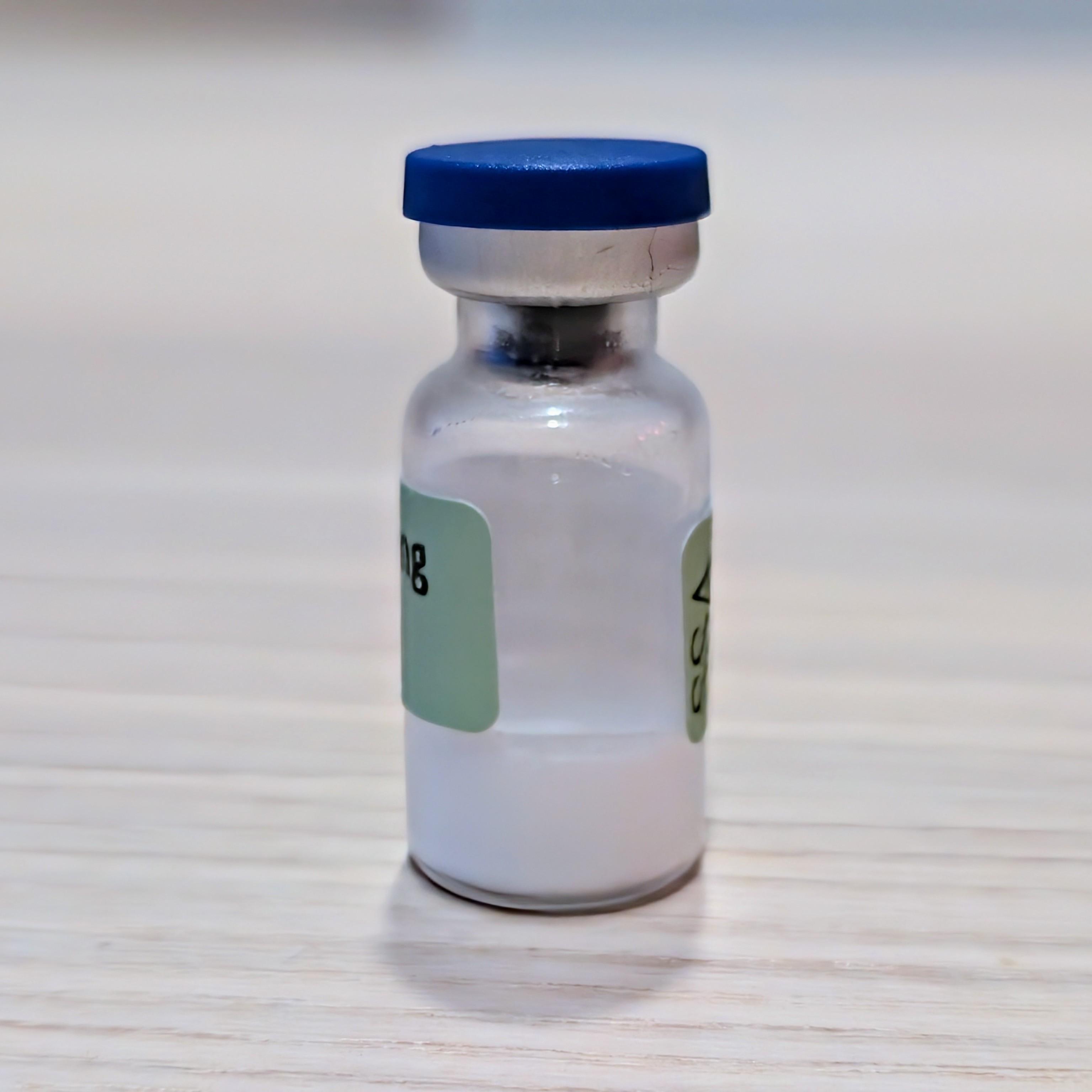
The solid holds its shape at the bottom. A neat puck does not tell you how many mg are inside.
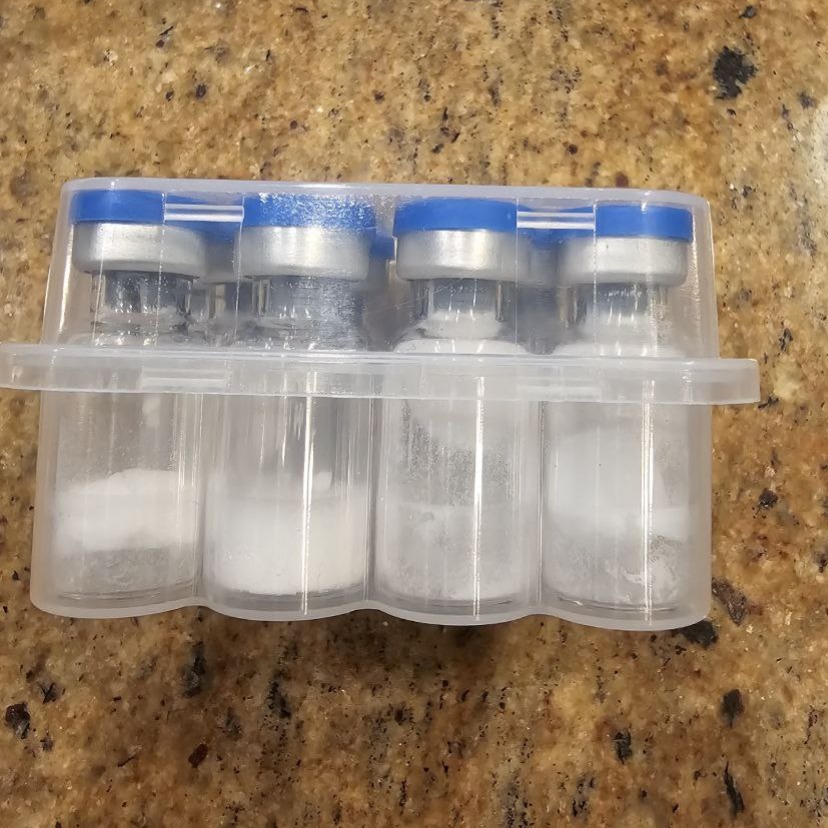
Breakage alone is not a red flag. Check the seal, color and any unexpected material just as you would with an intact puck.
Common appearances, not safety certificates. Tap a photo to inspect it more closely.
Dry-vial red flags: do not use
- Wet or sticky-looking material: unexpected moisture or a paste where dry powder is expected.
- Unexplained discoloration: a new or uneven color that does not match the documented formulation.
- Foreign material: dark flecks, fibers or other unexpected matter in the vial.
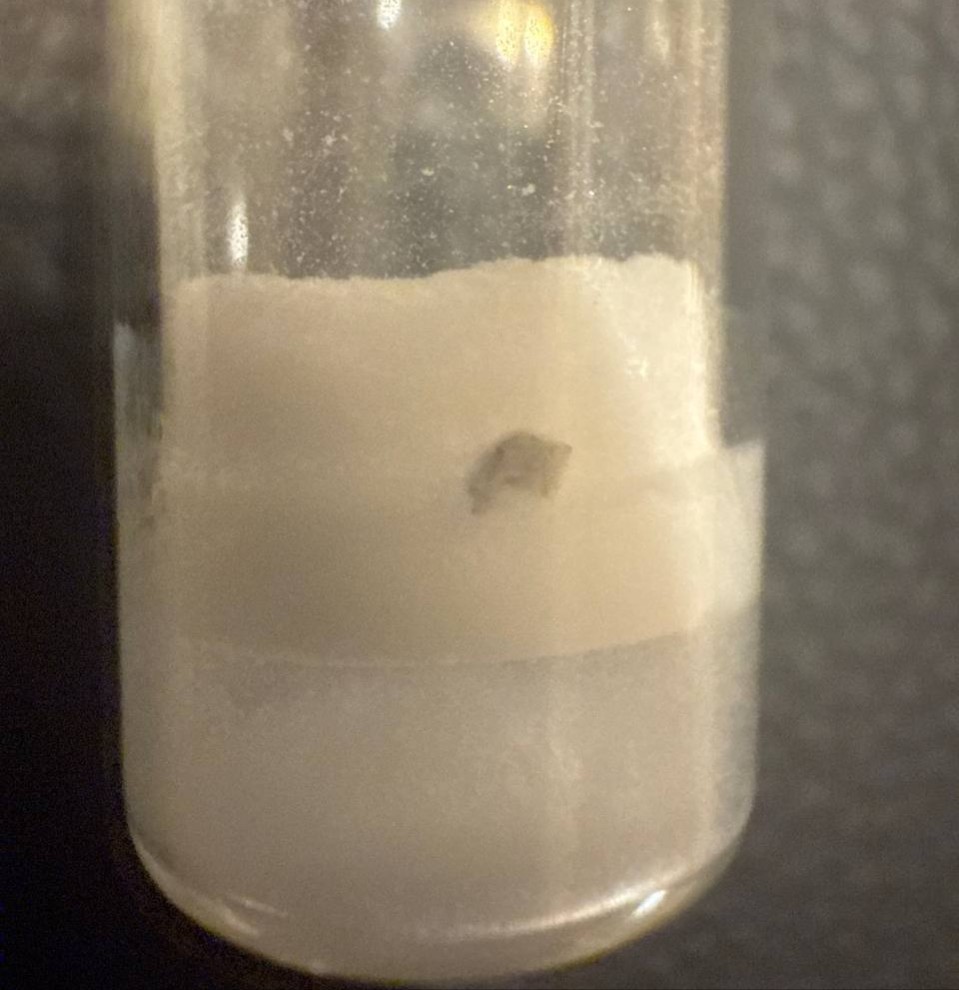
Do not dissolve or inject this vial to see whether the patch disappears. Photograph it and request a refund or replacement. You do not need to identify the speck before rejecting a suspect vial.
Color needs context. Some formulations have an expected tint; even the Lilly tirzepatide label describes its finished solution as colorless to slightly yellow. That does not explain a new dark patch in a dry vial. Compare with the exact product's documented appearance, not another seller's photo.
After recon: clear liquid vs. red flags
For a preparation meant to be clear, look for a transparent liquid without visible particles. Clear is an appearance check, not an injection green light. Bacteria, endotoxins and chemical impurities can be invisible.
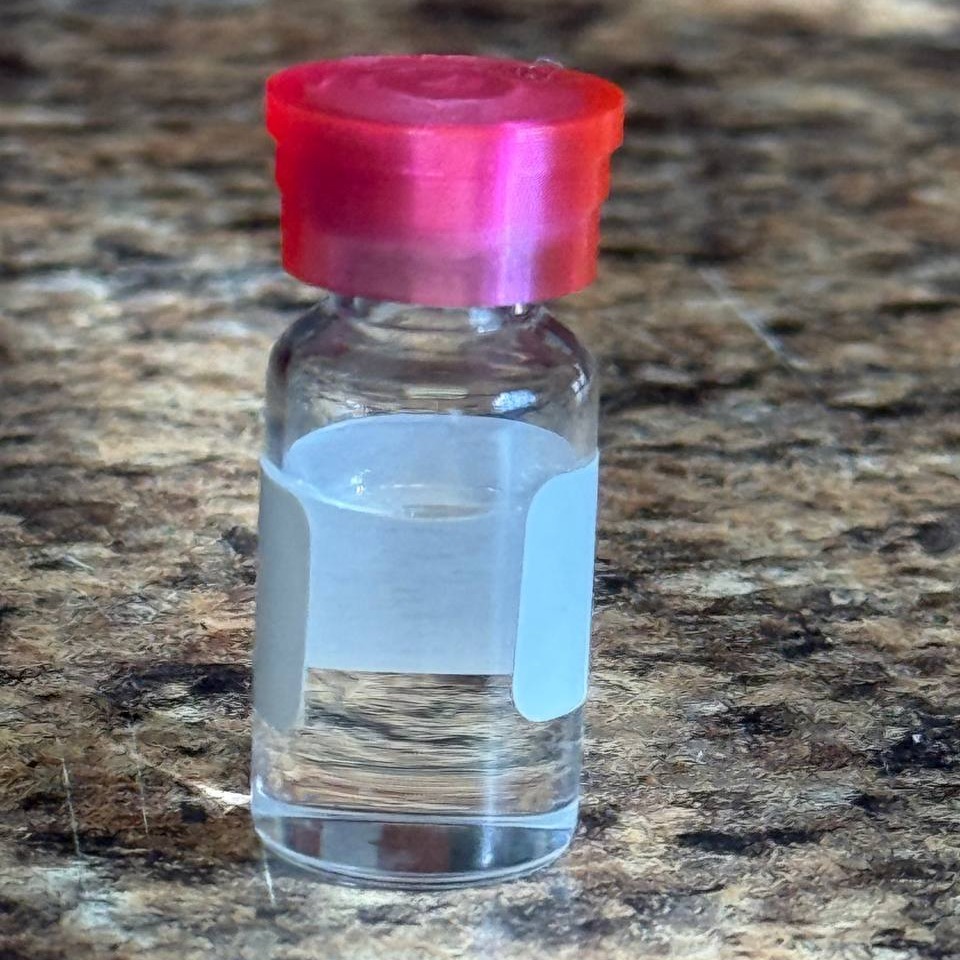
The background is visible through it. This is what clarity looks like; it does not show purity, identity or sterility.
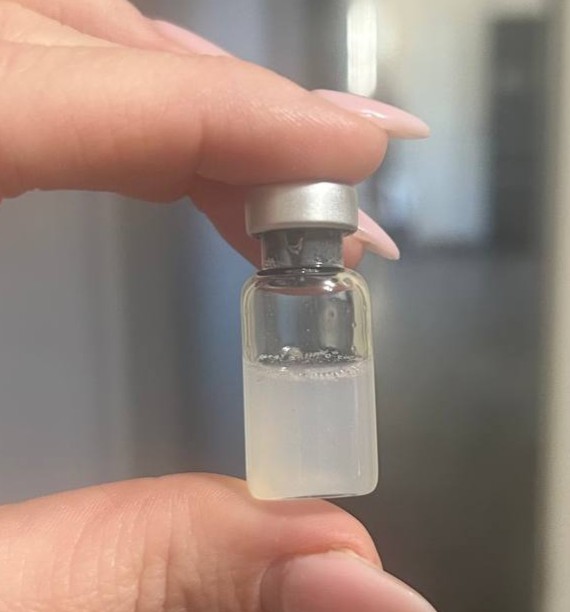
A preparation meant to be clear should not stay cloudy. Set it aside. Do not try a small dose to see whether it causes a reaction.
Three reasons to reject the liquid
- Cloudiness: persistent haze in a preparation that should be clear.
- Gelling: strings, clumps or jelly-like material instead of the expected free-flowing solution.
- Floaters: visible flecks, fibers or particles, even when the surrounding liquid looks clear.
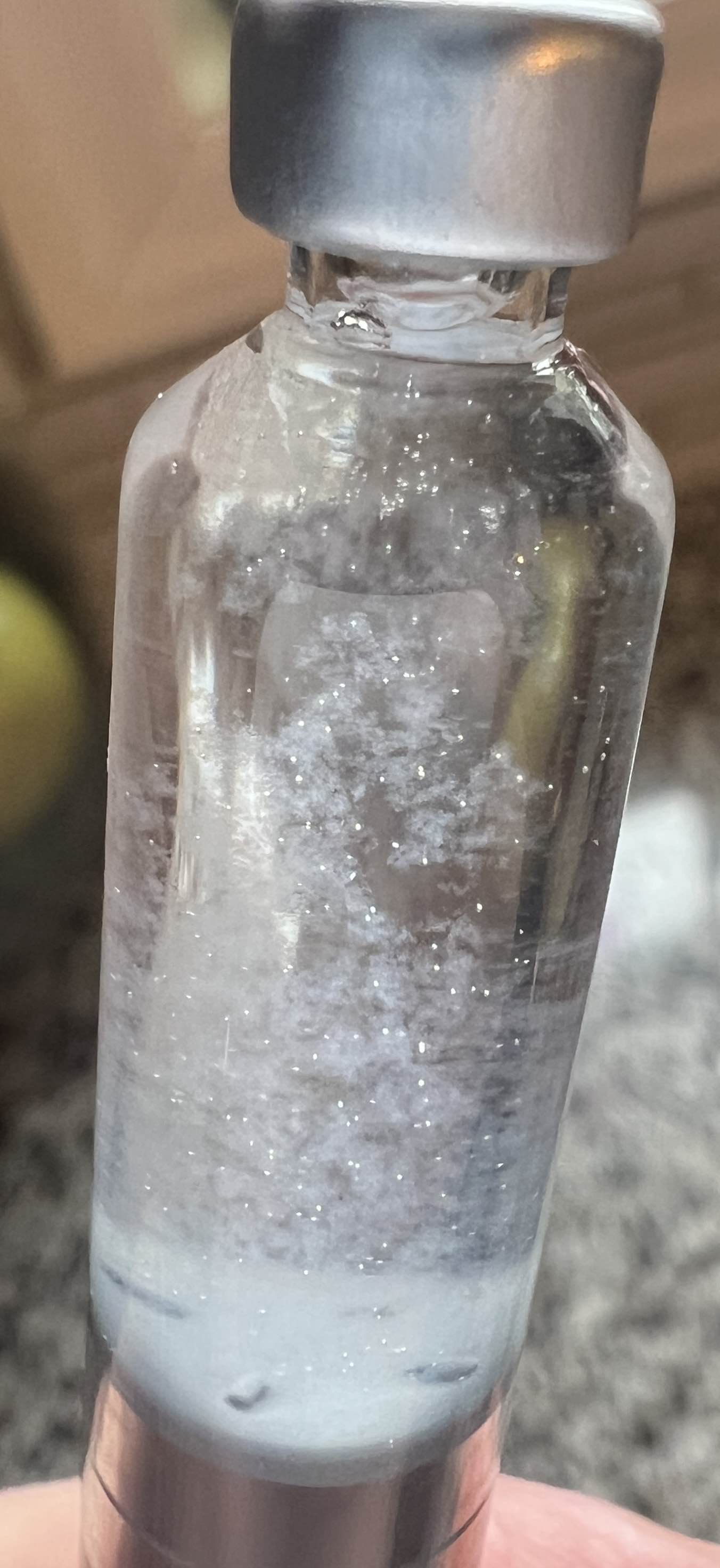
Reject an unexpectedly gelled preparation. Do not shake, heat or dilute it until it looks usable.
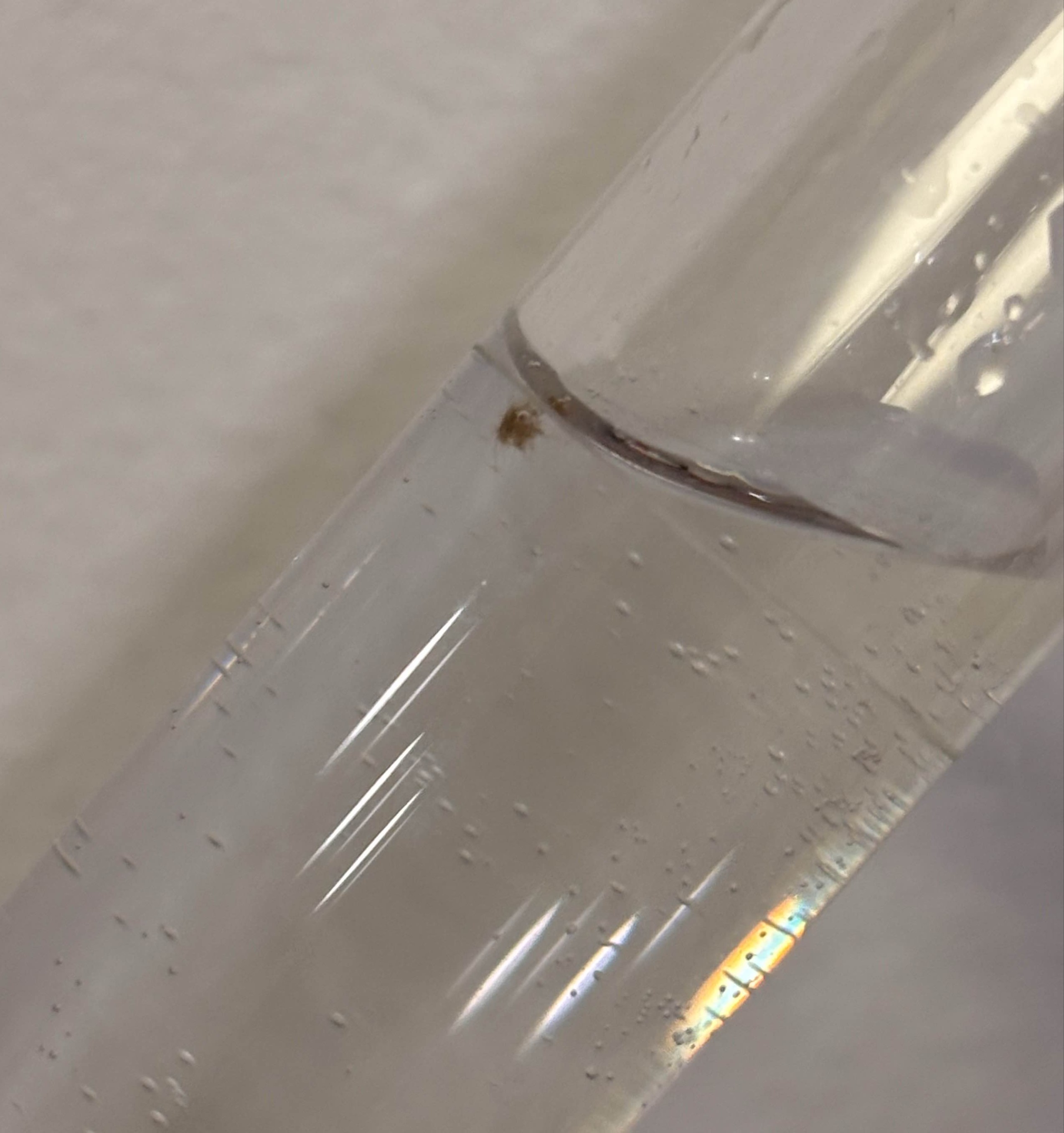
A dark speck in otherwise clear liquid is still a stop sign. Do not filter it out and assume the remaining liquid is safe.
Don't rescue a questionable vial to save the purchase price. Keep it separate while arranging a complaint or lab assessment; then use an appropriate medicine-disposal route. Never pass it to someone else.
Haze or gelling can have several causes, including undissolved material or aggregation—peptide molecules clustering together. You do not need to prove which one occurred before deciding not to inject. A photo cannot establish broken peptide chains or predict an immune reaction.
Can pH, moisture or a timer settle the question?
No single number can clear a suspect vial. These checks need specifications for the actual formulation, rather than a rule copied across every peptide.
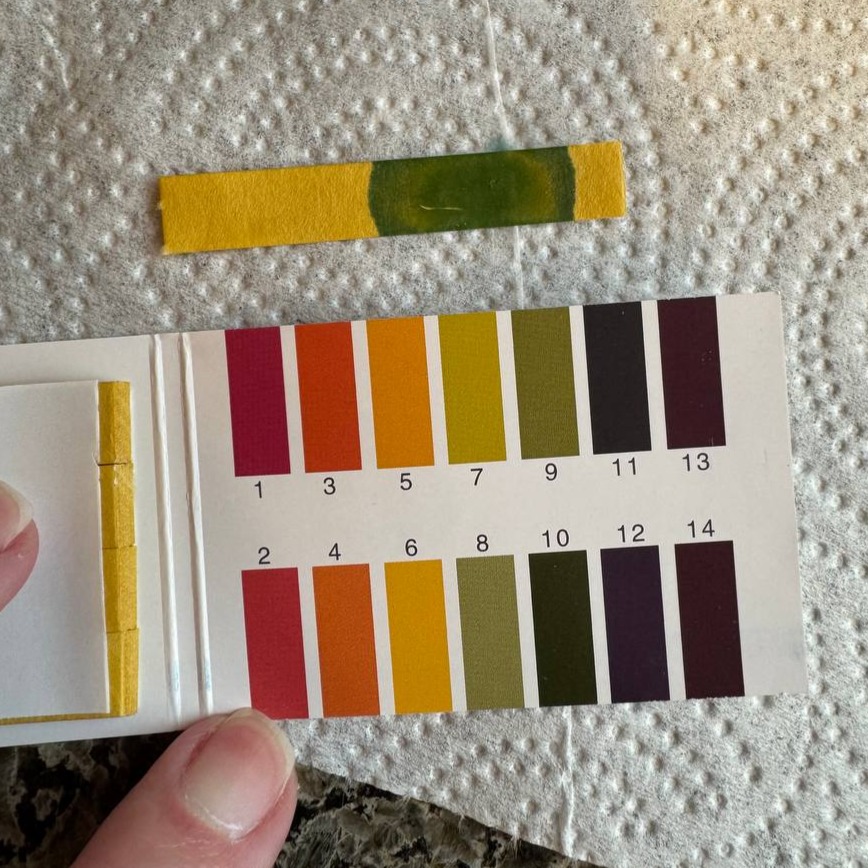
A strip gives an approximate color match. It cannot show whether a vial is sterile or free of endotoxins. Do not put a strip into liquid intended for injection.
- pH 6–9 is not a universal safe range. Ask for the range and test method for the exact formulation. Do not add acid or alkali to make an unknown preparation pass.
- “Under 3% moisture” needs a measured result. Dry-looking powder cannot confirm that percentage, and the acceptable moisture level depends on the product.
- 30 minutes is not a universal deadline. Dissolution time depends on the formulation and diluent. If a preparation remains unexpectedly cloudy or contains material, do not inject it; waiting longer is not a safety test.
These are separate, product-specific checks in ICH Q6A's specifications for injectable products. The practical rule stays simple: an unexplained red flag is a stop, even when another number looks fine.
Problem vial? Get a useful answer from the vendor
Photograph it, request a remedy, keep the reply
- Stop using it. Set it apart and keep the label and packaging. Do not alter it just to make a clearer photo.
- Capture the problem. Take a whole-vial shot and a close-up in steady light. A short video can show haze or material moving. Keep the original files.
- Send the facts. Include the order and batch, arrival date, whether it was unopened, and when the problem appeared. If already mixed, include the diluent, amount and storage history.
- Ask for a refund or replacement and a batch investigation. If the vendor dismisses it as “normal,” ask for evidence specific to that product and batch. A reassuring message is not a test result.
An example message: “This unopened vial arrived with a dark patch beside the puck. I've attached the label, whole-vial photo and close-up. Please arrange a refund or replacement and explain how you will investigate this batch.”
If the vendor will not resolve it, share a factual account with community moderators: what you received, your photos and the response. Remove private details and distinguish what you saw from an unconfirmed explanation. For testing, get the lab's sample instructions before sending or changing the vial.
Already used it and feel unwell?
Stop using that vial. Trouble breathing, swelling of the face or throat, fainting, or severe or rapidly worsening symptoms need urgent medical help. Fever, chills or a worsening injection-site reaction also need prompt assessment. Tell the treating professional exactly what you used and bring the product details. Do not wait for a vendor or chat group to diagnose it.
Keep storage and shipping in the picture
A dry vial and a mixed vial have different storage needs. Save the seller's storage claims and any known heat, freezing or shipping problems. Good looks cannot undo a storage problem. Gray 101: storage and handling
Looks fine? Next, check the report
Your eyes cannot tell 99% purity from 85%, count the mg in a vial or rule out endotoxins. That is where Testing 101 comes in: match the COA to the batch, check identity, purity and content, and understand which additional tests address contamination. An HPLC purity result is not an endotoxin or sterility result.
The takeaway
Don't reject a vial just because the puck broke. Do reject unexpected particles, persistent haze, gelling or a compromised container. Photograph the issue, pursue the refund, and don't use your body to settle a dispute with a vendor.
Continue reading
- Testing 101 — read the COA and choose the right tests.
- Residual Solvents — residues you cannot see in a vial.
- Injection Pens 101 — understand the pen and cartridge.
- All guides and posts